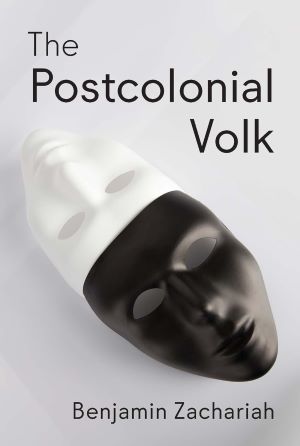
Benjamin Zachariah
The Postcolonial Volk
Polity Press, May 2026
Postcolonial theory and its bedfellow, decolonial theory, are the most flourishing products of academia in recent times. Transcending their origins in universities and literary criticism, and clustering around what is coming to be known as ‘theory from the Global South’, their guiding assumptions have leaked into the public domain and become shibboleths with which to acknowledge historically victimised communities. With this success has come a disturbing trend: political activity operates based on clumsy victimhood analogies, and much of its rhetoric is deliberately anti-rational, reproducing and perpetuating the manufactured categories of racist and sectarian imaginations.
‘The first two paragraphs of Zachariah’s The Postcolonial Volk grabbed me so thoroughly that I instantly knew a sleepless night was ahead of me … He shows that fascism is coming back not only in Trumpian populism; it is also alive and kicking in the anti-Eurocentrism that permeates today’s left. If you seriously want the authentic left to come back, drop everything else and read this book!’
SLAVOJ ŽIŽEK, University of Ljubljana
‘A tart, sarcastic and lethal polemic by a highly original thinker who is clearly unwilling and even unable to suffer fools gladly. Each page bristles with irony, insight and erudition.’
STEPHEN HOLMES, New York University
‘Rejecting the emancipatory claims of postcolonial/decolonial scholarship, Benjamin Zachariah charges it with indigenism, obscurantism and moral relativism … Essential reading for all who refuse to avenge Western brutalities by glorifying the worst of the East.’
CHANDAK SENGOOPTA, Birkbeck College, University of London
‘Benjamin Zachariah’s original and timely analysis of postcolonial thinking redirects our attention to deeper, structural, almost atavistic forces that linger on in the perpetuation of völkisch ideas that have done so much to pervert modern democracies and undermine global humanism.’
ROGER GRIFFIN, Oxford Brookes University
‘I have been impressed by this book, most importantly for its critique of the tendency to consider only “the oppressed” (or those who claim to speak for them) as legitimated to present and represent their experiences, struggles and resistances, their oppression being the unique basis for the right to speak.’
LUISA PASSERINI, European University Institute, Florence
Interview:
»Erdoğan, Modi, sogar Putin – sie geben sich alle dekolonial«, Jungle World, 23. Juli 2026
Rezensionen:
“Recycelte Ideologie”, Jungle World, 9. Juli 2026
„Das wichtigste universelle Recht ist heute das Recht, beleidigt zu sein“,, Ruhrbarone, 18. Juni 2026